
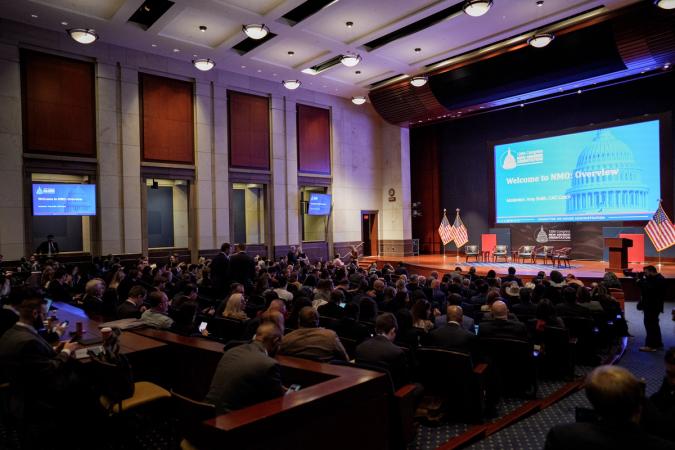
The next Congress will write rules for AI and emerging tech. They should use the stuff first.
🔎 Nguồn: Chuyên ngành · Bài viết thể hiện quan điểm cá nhân/bình luận chính sách thay vì tin tức thời sự kiểm chứng.
Original (en)
The next Congress will write rules for AI and emerging tech. They should use the stuff first.
The best thing industry leaders can do is to invest the time to ensure this country’s policymakers can experience the technology they’re regulating up close, writes Allie Page, executive director of American Innovation Project.

This election has made clear that emerging technologies like artificial intelligence or Super intelligence (AI/SI) are going to be regulated imminently. Concern about data centers, AI, and new technologies surfaced in campaigns across the country, and in January 2027, the 120th Congress will decide how to tackle the challenge of regulating these complex, fast-evolving technologies.
Grayscale opens in-kind crypto ETF investing to more investors
0 seconds of 11 minutes, 12 seconds Volume 0%
Press shift question mark to access a list of keyboard shortcuts
Keyboard Shortcuts Enabled Disabled
Shortcuts Open/Close/ or ?
Fullscreen/Exit Fullscreen f
Decrease Caption Size-
Increase Caption Size+ or =
CZ on Binance's $6.3B hack
0.5x 1x 1.25x 1.5x 2x
Auto 1080p 720p 406p 270p 180p
Whether that happens, though, is a policy outcome, one that depends on policymakers who understand what they are regulating. The gap between how fast the technology moves and how well Washington understands the technology is the difference between leading internationally and lagging behind international competitors, like China. Closing that education gap starts with a simple principle: the people writing the rules should have hands-on experience with the technologies that they are regulating.
It’s easier to be hands-on with some technologies over others. For example: Congressional leaders can experiment with some technologies from their own devices, like sending a stablecoin from a centralized crypto exchange, asking an AI chatbot a question about their district, or viewing results of a prediction market. Meanwhile, other tech can be more complex, and it is often helpful to get a demo or hear from the software developers or builders directly about how the technology functions and/or why it was developed (e.g., the difference between centralized finance and decentralized finance, open versus closed source AI, or how national security innovation works). It is unquestionably useful for a Member to interact directly with someone who uses the technology every day, so they can ask questions in real-time and share any worries they have. In every case of hands-on experience, a Member leaves with a better understanding and the ability to ask sharper, more thoughtful questions, grounded in their own experience rather than second-hand explanations.
The new class of Congressional leaders arrives in Washington DC in January 2027 with a clear expectation from their constituents to make things in America work better, and most of them have not yet formalized their views on AI, crypto, prediction markets, or the infrastructure underneath it all. First-term members, especially, are building their staffs, their networks, and their policy priorities. This class is one of the largest in years, so we should expect lots of open, curious minds looking to learn and build new connections across industries. What members-elect experience in their first months on the Hill will shape how they legislate for years to come.
This goes for Congressional staff as much as Members. A new office hires its legislative team in its first weeks, and these leaders will be on the frontlines of taking industry meetings and drafting legislative language. Many of the staff working on tech policy are learning about these issues in real-time, as the tech is fast-moving and ever-evolving. Through public and private partnerships, we have a unique opportunity to work together to help newly elected Congressional leaders and their staff experience emerging technologies firsthand, so they are ready to write the rules that will govern U.S. technology for decades to come. In order to achieve this, it is critical that our industry is ready to show up with the technology, offer demos, and be ready to answer all types of questions.
Policymaker education on emerging technology has never mattered more. Voters put emerging technologies on the agenda this fall, and the 120th Congress will now decide whether the U.S. leads or lags. The best thing industry leaders can do is to invest the time in ensuring this country’s policy leaders can experience the technology they’re regulating up close. We’re looking forward to having the opportunity to do just that in January.
Note: The views expressed in this column are those of the author and do not necessarily reflect those of CoinDesk, Inc. or its owners and affiliates.

1. 1Jupiter adds Anchorage-backed USDGO to its $1 billion Solana lending platform47 minutes ago
2. 2Nvidia shares plunge as much as 14% as Jensen Huang resigns1 hour ago
3. 3Bitcoin weakness erases September's bullish signal3 hours ago
4. 4UK bank Griffin raises $20 million to expand into stablecoin payments3 hours ago
6. 6Bitcoin dips with Nvidia as ETF outflows reach day five4 hours ago
7. 7Polymarket trims workforce under investor pressure as Kalshi surges ahead4 hours ago
8. 8Nomura weighs Laser Digital sale as European losses hit four straight quarters5 hours ago
9. 9India’s financial crimes watchdog raids crypto exchanges CoinDCX and Delta over alleged illegal cross-border trades5 hours ago
10. 10Live updates: Bitcoin slumps below $72,000 as Nvidia's Huang resigns, interest rates surge6 hours ago

Diversified RWA stablecoins sustain 5-7% yield from real credit as crypto funding compresses to ~4%. GENIUS pushes yield off-chain; TAM grows to $4B in 3 years.
Commissioned byRealFi
Diversified RWA stablecoins sustain 5-7% yield from real credit as crypto funding compresses to ~4%. GENIUS pushes yield off-chain; TAM grows to $4B in 3 years.
Diversified RWA stablecoins sustain 5-7% yield from real credit as crypto funding compresses to ~4%. GENIUS pushes yield off-chain; TAM grows to $4B in 3 years.
#### Will stablecoins survive once the banks catch up? #### The election changes Washington. The work on crypto continues #### Big crypto wants the one thing it can’t buy: your vote
You have 2 articles remaining this month.
Get unlimited access — create a free account.
© 2026 CoinDesk, Inc.
Disclosure & Polices: CoinDesk is an award-winning media outlet that covers the cryptocurrency industry. Its journalists abide by a strict set of editorial policies. CoinDesk has adopted a set of principles aimed at ensuring the integrity, editorial independence and freedom from bias of its publications. CoinDesk is part of Bullish (NYSE:BLSH), an institutionally focused global digital asset platform that provides market infrastructure and information services. Bullish owns and invests in digital asset businesses and digital assets and CoinDesk employees, including journalists, may receive Bullish equity-based compensation.
Consent Leg.Interest
[x] checkbox label label
[x] checkbox label label
[x] checkbox label label
- [x] checkbox label label
Reject All Allow All